What the blocks are sitting on
A block-paved drive is a flexible pavement. The blocks are the wearing course. Under them, a typical specification is a dug-out formation, a geotextile if the soil is soft, a compacted layer of crushed stone, a laying course of sharp sand, then the blocks, then kiln-dried sand swept into the joints and the whole thing whacked down. Edge restraints, usually concrete kerbs or a haunched block edging, stop the field spreading.
Firms use different words for the same layers. One quote may say "MOT Type 1" and another "crushed stone sub-base". Ask for the depth after compaction, not the depth of loose stone tipped in the hole. On soft ground the depth has to increase, or the blocks will rut at the wheel tracks. Hull's superficial geology is often till, alluvium or tidal clay and silt. That is a reason to insist on a site visit before anyone names a depth.
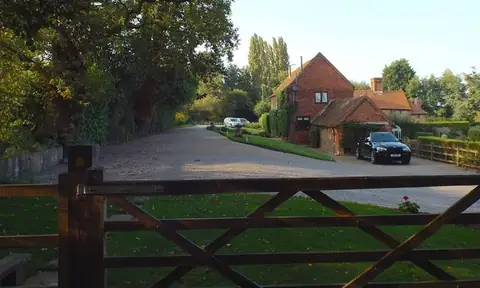
The photograph above is a block-paved drive at Walsal End in Solihull. It is not a drive in Hull, and it is not work arranged through this site.
Patterns, and why they are the small decision
Herringbone resists braking better than a simple stretcher bond because the joints don't line up with the wheels. Stretcher bond uses fewer cut blocks and looks quieter on a short garden. A fan or circle at the entrance adds cuts and waste. Colour is fashion: a charcoal block and a brindle block can sit on the same base. If two quotes differ only by the colour name, they have not yet told you about the excavation.
Blocks come in standard concrete, tumbled blocks that look older, and clay pavers. Clay costs more and is usually reserved for a path or a small court. For a parking area, concrete blocks are the common choice because they are made to a thickness that takes a car. Ask which thickness is priced. A 50 mm block is a pedestrian unit. Drives need the thicker paving block.
Edges, manholes and the fall
Front gardens in streets such as Bricknell Avenue and Newland Park often have a gate, a path to the door, and a manhole somewhere inconvenient. The blocks have to be cut around the cover, and the cover may need raising to the new level. A quote that says "manholes included" should say whether that means a new frame or only a cut around the old one.
Water should fall away from the house, toward a border that can take it or toward a channel. A block surface with sand-filled joints is not fully sealed, but it is not a soakaway either. The Planning Portal explains the national rule for front gardens: a new or replacement hard surface of more than five square metres needs planning permission if the rainwater does not drain to a permeable area within the boundary, or if the surface itself is not permeable. Block paving can be laid as a permeable system, with open joints and a different base, but only if the quote says so. A standard sand-jointed drive is usually treated as impermeable.
The crossing is a separate job
Inside Hull, driving across the pavement needs a dropped kerb approved by the city council, built by a contractor the council has approved. That work is highway work. It is not included just because a block quote mentions "the kerb". Read the dropped kerbs page before you compare totals. In conservation areas such as the Avenues and Pearson Park, or Garden Village, planning permission can be required for the crossing or the hard surface even when a street nearby would not need it.
What to line up in the quotes
Ask each professional the same five things: compacted base depth, block thickness and whether it is a paving block, edge detail, how rainwater leaves the garden, and whether the highway crossing is in their price or still to be agreed with the council. A cheap quote that stops at the boundary and a dearer quote that includes the crossing are not the same offer.
This page cannot tell you a rate per square metre. Hull Driveways does not price work and does not publish sample bills.
Questions about block paving in Hull
Can blocks go straight onto the old concrete?
Sometimes a firm will lay blocks over a sound concrete slab with a sand or mortar bed. If the slab is cracked or holding water, it is the wrong starting point. Ask them to say what they found, not what they hope.
Do the joints need sealing?
Sand-filled joints are the ordinary finish. A sealing coat is an extra. It changes the look and the maintenance, and it can affect how the surface sheds water. It should be a separate line if it is offered.
Who do I pay?
If you accept a quote, you pay the professional who gave it. This website does not invoice you for the blocks.
Sources: Hull City Council dropped kerbs; Planning Portal: paving your front garden; BGS Geology Viewer.