Loose stone needs a frame
Gravel is not a structural surface. The stones sit in a retaining edge, usually timber, steel, concrete kerb or a row of blocks, deep enough that they are not kicked onto the pavement. A weed membrane under the stone slows growth. It does not stop ruts. Where wheels turn, the stone is pushed aside and the membrane shows. A cellular grid, filled with gravel, keeps the stones in pockets and spreads the car's weight. It costs more than a simple tip of chippings and should be its own line on a quote.
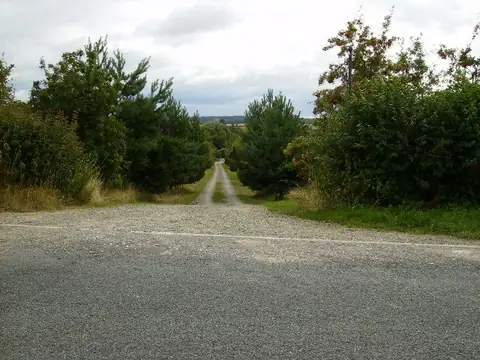
The photograph above is a gravel driveway beside the B4361 in Herefordshire, not a gravel drive in Hull.
Depth matters more than colour. A thin scatter looks finished for a month. Ask how many millimetres of stone are priced after settlement, and which aggregate: angular granite stays put better than rounded pea gravel, and it is harsher underfoot. Pea gravel is the one that travels into the house.
The entrance is the failure point
Stones on the public footway are a nuisance and can be a highway issue. The practical detail is a bound or block apron for the first metre or two inside the boundary, so the tyres are clean before they cross the pavement. A quote that runs gravel right up to the back of the footway is the one that sheds stone.
The dropped kerb, if you need one, is still a council matter. Hull City Council expects the crossing itself to be a proper constructed surface, usually tarmac. Gravel is not that surface. East Riding villages such as Cottingham use that council's rules instead. Northgate is a village street: loose stone and a historic frontage do not automatically go together, and you should read East Riding's note that a vehicle crossing may need planning permission.
Drainage, which is gravel's real advantage
Because the surface is open, rain can soak through it if the ground below will take water. On heavy clay it will not soak away forever; it will sit in the stone and then run to the lowest edge. That is still often better than a sealed slab sending a sheet of water to the road, and it is why the Planning Portal treats permeable surfaces differently from sealed ones. A gravel drive can be a permitted-development way to cover a front garden, provided the rest of the rules are met. It is not an exemption from a dropped-kerb approval.
Kingswood's edge, where new houses meet open fields, is one of the places a longer gravel drive is plausible because the plot is not a two-metre terrace yard. A yard that small is a poor home for loose stone: there is nowhere for it to be swept back to.
Conservation areas
Hull publishes 27 conservation areas, including the Avenues and Pearson Park, Garden Village, Newland and Sutton Village. In some of them an Article 4 direction takes away the usual right to lay a hard surface or a crossover without planning permission. Gravel is still a surface. Do not assume "it's only stones" means no permission. The Avenues and Garden Village pages point at the council documents.
Questions about gravel in Hull
Will gravel be enough for two cars every day?
Often no, unless a grid is used and the entrance is bound. Daily turning on loose stone digs holes. Say how the drive is used when you ask for quotes, so the professionals are pricing the same habit.
Can the stones match a photograph I like?
Colour samples differ from wet stone on site. Ask for a sample you can see outside, and treat any picture on this website as someone else's photograph.
Who maintains it?
You will top up stone over the years if it is loose. That is ordinary ownership, not a contract with Hull Driveways. This site does not supply aggregate.
Sources: Planning Portal: paving your front garden; Hull City Council dropped kerbs; Hull City Council conservation areas.