Compare behaviour, not slogans
Block paving is many small units on sand over a crushed-stone base. A section can be lifted if a manhole has to be reached or if one corner settles. The look depends on the block and the pattern. The strength depends on the base and the edge restraints. On a fussy front garden with a path, a step and two covers, blocks are often the practical choice because the cuts follow the shape.
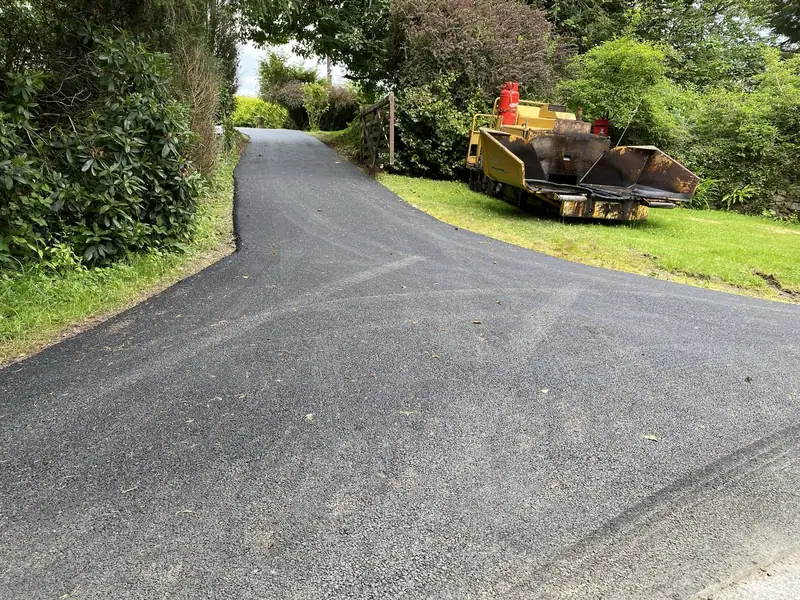
Asphalt is a hot-laid sheet. It is quick on a simple area and it is what Hull's council says it usually wants on the public crossing. It is sealed, so the rain has to be given somewhere to go. It is a poor match for a garden you expect to alter next year, because you cannot lift a neat patch and put the same sheet back.
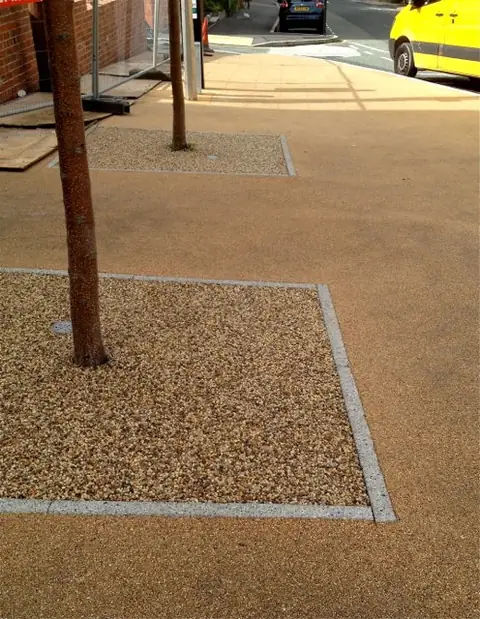
Resin-bound paving is a thin mixed layer of stone and resin on a firm base, usually asphalt or sound concrete. It looks like a smooth gravel carpet and it can be specified as permeable or sealed. It shows cracks if the base moves. The product name has to say whether it is UV-stable resin and whether it is the bound system or the bonded scatter-coat. Those are different things. The resin page separates them.
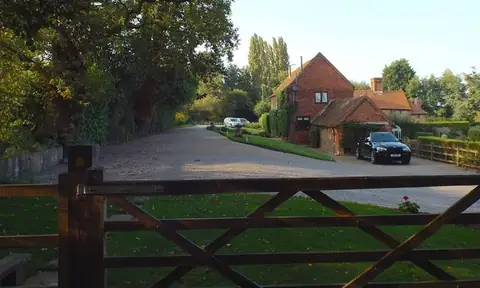
The three photographs on this page show paving elsewhere in Britain. None of them is a drive in Hull.
Hull's ground does not pick a winner
The geological picture for the city is till, alluvium and tidal clay and silt over chalk, with real variation street by street. A flexible block pavement tolerates a little movement better than a rigid printed slab, and a resin layer tolerates almost none. Asphalt sits in between if the base is thick enough. That is a reason to let someone look at the garden, not a reason to ban a surface from the whole city.
The rules do not pick a winner either
The Planning Portal cares whether the front garden deals with rainwater, not whether the brochure says "premium". Hull's crossing rules care who is allowed to touch the footway. Conservation-area rules care about some streets and not others. A resin court in the Avenues can be the option that needs permission, while the same court on a modern close does not. Read the planning guide for the street you actually have.
A way to ask for like-for-like quotes
If you are undecided, say so in the quote form: ask for the same area priced in two surfaces, with the base and the crossing described. You will not always get both. Professionals choose what they want to price. This website will not fill the gap with a made-up saving.
Gravel and pattern-imprinted concrete are left off this three-way note on purpose. They fail and succeed for different reasons, covered on their own pages: gravel and imprinted concrete.
Questions about choosing a surface in Hull
Which one lasts longest?
Anyone who answers with a single number of years, without seeing the base, is guessing. Maintenance differs: blocks need joint sand occasionally, asphalt can be patched, resin may want a conversation about sealer. None of those is a guarantee this site is allowed to give, because this site does not do the work.
Can I mix them?
Yes, and many gardens do: asphalt or blocks on the turning area, a bound strip at the door, gravel only where feet rarely go. The quotes should show the join, because the join is where they crack or spill.
Do you have a preferred contractor for one of them?
No. The form does not steer you to a named firm. Local professionals may contact you. This site does not install the drive.
Sources: Planning Portal: paving your front garden; Hull City Council dropped kerbs; BGS Geology Viewer.